History
Hitler's Secret Missions
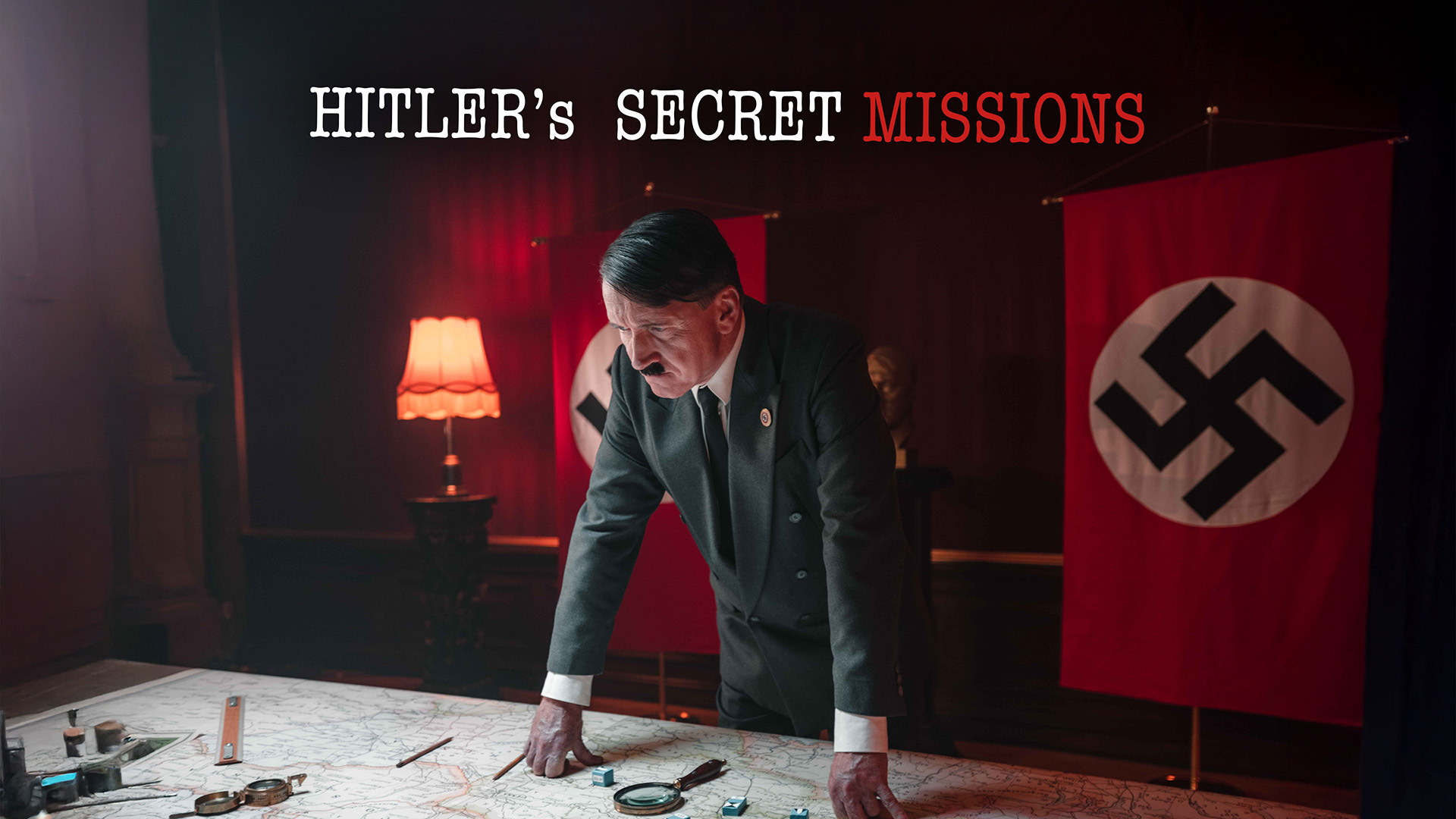
“Hitler’s Secret Missions” explores six of the most audacious and ruthless operations ordered by the Führer — covert plans designed to shape the fate of Europe, alter the course of WWII, and decide its ultimate outcome.
“Hitler’s Secret Missions” explores six of the most audacious and ruthless operations ordered by the Führer — covert plans designed to shape the fate of Europe, alter the course of WWII, and decide its ultimate outcome.
- Production Company
- Big Media
- Duration
- 6x60'
- Original Language
- English
- YOP
- 2023
- Definitions
- HD
- Content Type
- Series
- Contemporary History
- Military & War
Synopsis
6 secret, politically sensitive and highly complex missions. All high risk with completely different outcomes. All designed and commissioned personally by Adolf Hitler and executed by his best commanders. After careful and detailed research in the German, English, Italian state archives and in the secret archives of the Vatican, these stories can now be told. ‘Hitler’s Secret Missions’ is a thorough and in-depth investigation into these audacious, daring and ruthless operations, designed and ordered by Hitler, as he set out to control the fate of Europe and determine the course of WWII and its final outcome.
Hitler's Secret Missions
1. Operation Himmler
On August 31, 1939, Nazi troops wearing Polish army uniforms launched a fake attack on the German radio station of Gleiwitz: the episode served Hitler as a major excuse to justify the invasion of Poland to public opinion. , which took place exactly the day after, September 1st, the date that officially marked the beginning of the Second World War. Hitler himself had given a mandate to Heinrich Himmler, then commander of the SS, to organize a sort of incident that could justify the initiation of hostilities with Poland in the eyes of the rest of the world. Reinhard Heydrich, head of the Gestapo, personally took over the coordination of the operation that was prepared in the strictest secrecy: a few dozen soldiers, almost all of the SS, were sent to Gleiwitz carrying weapons and wearing uniforms at the time supplied by the army Polish. At the head of this handful of soldiers, a young Nazi fanatic philosophy student, Alfred Helmut Naujocks. On the evening of August 31, a phone call from Heydrich triggered the operation: Naujocks' men attacked the radio station and, to make everything more credible, they also killed their fellow citizens, the German personnel who were in the station, who in absolute good faith tried to defend himself from the Polish "invader". At the end of the assault, a real guerrilla operation, the fake Polish soldiers read seditious messages on the radio that incited the Polish minorities in eastern Germany to arm themselves against the German people. The terrible German propaganda machine did the rest: a few hours later, in fact, Hitler invaded Poland.
2. Operation Bernhard
Operation Bernhard was the codename for a secret German plan, developed during World War II, whose main objective was to undermine the British economy through the massive release of counterfeit £ 5, £ 10, £ 20 banknotes and £ 50. The fakes were supposed to increase inflation and thus destroy the enemy's economic and financial system. The first phase was handled in early 1940 under the title of Operation Andreas, also known as Operation Andrew. The unit successfully duplicated the banknotes used by the British, produced nearly identical engraving blocks and deduced the algorithm used to create the alpha-numeric serial code on each banknote. The unit was closed in early 1942 after its boss, Alfred Naujocks, fell out of favor with his superior officer, Reinhard Heydrich. The operation was later named after the SS captain Bernhard Krüger, formerly an expert in passport forgery, who was responsible for it.The printing of banknotes, which began in 1942, took place at barracks 18 and 19 of the Sachsenhausen concentration camp located 35 kilometers north of Berlin, thanks to the work of 137 Jewish deportees of 13 different nationalities, all professionally skilled in printing on paper. Much of the counterfeit money, enclosed in metal boxes, was thrown by the Nazis in the last days of the war in Lake Toplitz, Austria.
3. Operation Willi
Edward, the Duke of Windsor and former King of England, never made a secret of his admiration for the Nazi regime after his trip to Germany in 1937, a visit that was financed by the Fürher himself. When the war started, Hitler was betting in the former monarch’s sympathies for a plan that contemplated returning him the crown of a new pro-Nazi English Kingdom, controlled by the Reich. The Duke, who was in France at the time the German troops marched over Paris, escaped to neutral Spain and the Nazis wanted to hold him in that country in order to negotiate with him. When Edward moved further to Portugal, and attempts to persuade him to return to Spain failed, Hitler nominated Walther Schellenberg, one of the most renowned agents of the SD (SS intelligence division) to launch Operation Willi. The goal was to persuade the Duke to return to Spain by convincing him that there was a conspiracy against him from the British Intelligence. If that failed, then Schellenberg had orders to Kidnap him. In this episode we will tell how the SD secret agents operated, and why this ambitious and daring plan that could give the Nazis a definitive advantage over the Allies, would fail in the end.
4. Operation Gran Sasso Raid
The feat that made possible the release of Benito Mussolini from his imprisonment on the Gran Sasso plateau was one of the most dramatic operations carried out by special forces in military history. After being arrested on 25 July 1943 by his own officers, the Duce had been transferred to the Campo Imperatore hotel, an isolated mountain resort (accessible only by cable car), where he was watched. Hitler ordered the paratrooper general Kurt Student to organize a mission for the liberation of the Italian dictator, using his Fallschirmjäger, a highly trained special unit, and, for political reasons, an SS unit under Captain Otto Skorzeny. On September 12, 1943, Student's paratroopers launched a daring assault with gliders, the aim of which was to surprise the Italian garrison guard and free Mussolini. This episode reconstructsthe military action in detail and analyzes its consequences
5. Operation Rabat
In September 1943, Adolf Hitler, furious at Mussolini's ouster, sent German troops to Rome and ordered SS General Karl Wolff, who had been Heinrich Himmler's main aide, to occupy the Vatican and kidnap (and possibly kill ) Pope Pius XII. At the same time as they planned to deport Rome's Jews to Auschwitz, Wolff began to play a dangerous game: blocking Hitler's plot against the pope, which he hoped would save him from the noose in case Germany lost the war. To save Pius XII, Wolff and other conspirators blackmailed him into silence when the Jews were rounded up, hoping that Hitler would cancel his order. A story of intrigue and betrayal, one of the most important stories ever told of the Second World War. In this episode we will try to nvestigate what is true in all of this. Is there any documented evidence in this incredible story? What went wrong? How was Pius XII saved?
6. Operation Greif
In the final months of WW2, the Third Reich was being squeezed by the steady advance of both fronts. Undeterred by the constant defeats, Adolf Hitler ordered his last great counter-offensive in the Ardennes, that would become known as the Battle of the Bulge. Among the missions carried on this winter campaign, one of the most dangerous and ambitious was Operation Greif. Personally planned by the Führer himself, It consisted of infiltrating special Waffen-SS units behind the enemy lines by disguising them as American soldiers and create havoc among the Allied troops. A mission so secretive, that even those who participated in it didn’t have a clue what they were training for a very long time. To lead this Operation, Hitler would once again trust his star Commando Otto Skorzeny, who had successfully liberated Mussolini with Operation Eiche and overthrew the Hungarian regent Miklós Horthy with Operation Panzerfaust, earning by the US intelligence the nickname of “the most dangerous man in Europe.” Using English speaking German soldiers, dressed in GI Uniforms and using captured US military equipment, Skorzeny would succeed in launching chaos among his enemies to the point that even General Eisenhower would feel threatened. Yet, many of his men would be captured and promptly executed.
.jpg)