History
How To Lose A War
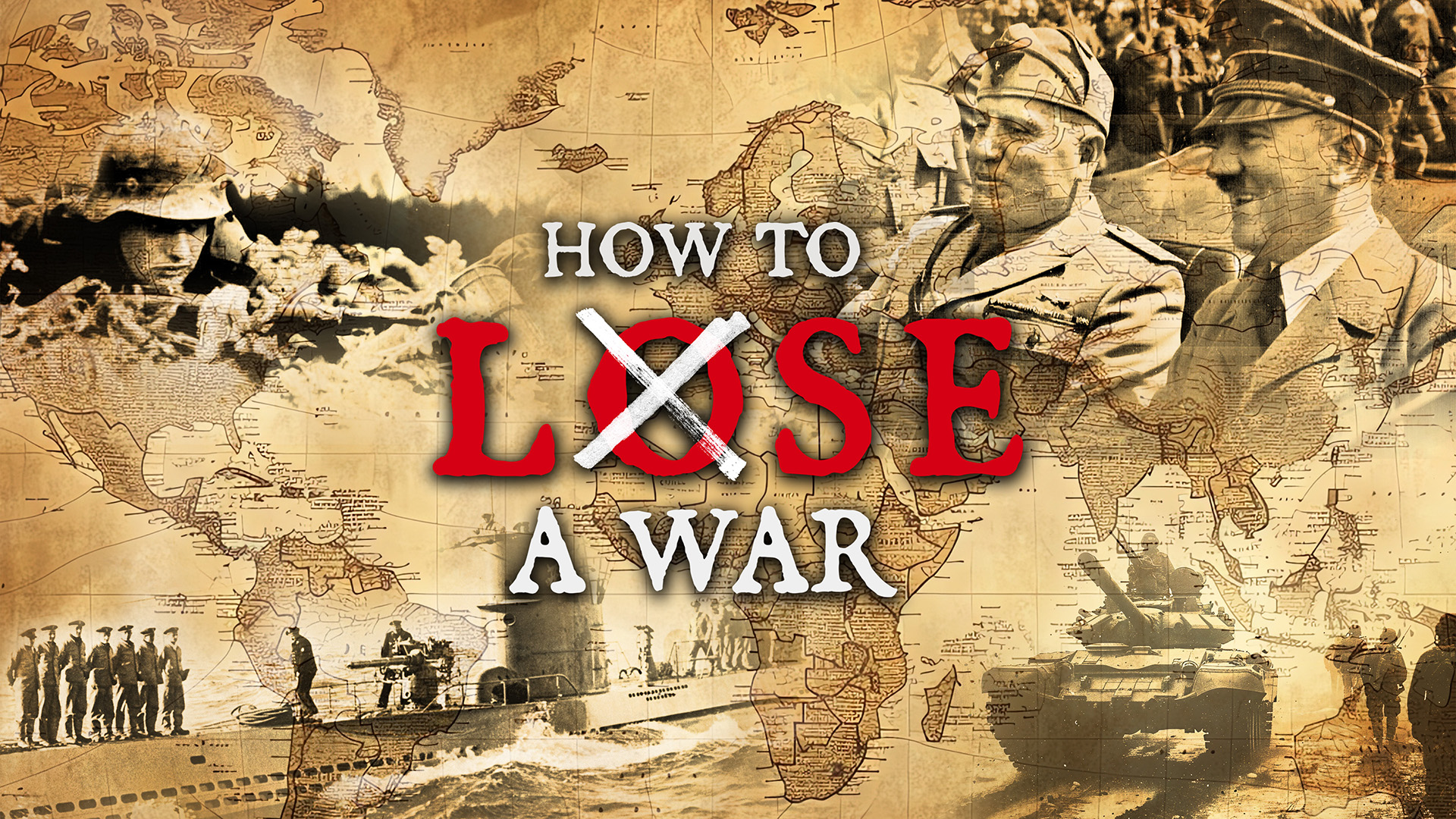
‘How to Lose a War’ offers a fresh perspective on the story of 1939-1945 - the second world war.
‘How to Lose a War’ offers a fresh perspective on the story of 1939-1945 - the second world war.
- Production Company
- Wildbear Entertainment / Cut2Clock
- Duration
- 5x60'
- Original Language
- English
- YOP
- 2023
- Definitions
- HD
- Content Type
- Series
- Contemporary History
- Military & War
Synopsis
In 1941, the Axis powers of Germany, Italy and Japan seemed to be on the brink of conquering the entire world. World War 2 began with a series of swift, stunning and decisive victories as the Axis powers completely took the Allies off-guard. By late 1941, Adolf Hitler ruled over a vast empire that covered Europe, large parts of Russia, North Africa and the Mediterranean. Germany occupied swathes of lands with a population greater than that of the United States. Hitler’s Axis ally, Japan, ruled over an empire that was even larger in size. The war, it seemed, was won. And then they lose it all. But how? In five themed episodes, How To Lose A War looks at the numerous missteps that turned the Axis powers‘ devastating victories into crushing defeats.
How To Lose A War
1. Best Laid Plans
In episode one we examine how the seeds of Japan’s defeat in 1945 was actually sown a decade earlier with the occupation of Manchuria in China. The so-called “Manchurian incident” led to a full scale war in China. But this war had no plan and no determined outcome. Instead, the war and the atrocities committed meant that Japan became internationally isolated, a world pariah. This escalated to a series of increasingly desperate gambits that led to Japan declaring war on the US, which culminated in the nuclear bombs being dropped and Japan’s surrender. It wasn’t just lack of a plan, the Axis powers also employed the wrong plans. Hitler’s decision to invade the island of Crete instead of Malta proved very costly to the campaign in North Africa and ultimately the flawed invasion of the Soviet Union. And Hitler’s invasion of the Soviet Union was planned through a racial prism – a bigoted belief in the racial inferiority of the Russians and a mistaken assumption they would quickly crumble. Nor were the Axis powers very good at planning together. Unlike the Allied powers their alliance didn’t have unified goals or targets. They rarely communicated their own plans to each other. Japan was taken by surprise when Hitler invaded Russia, and equally, Hitler had no idea that Japan would bomb Pearl Harbour.
2. The Men Who Gave The Orders
This episode explores the men in charge whose rampant egos and misguided belief in their own abilities led to their country making fatal mistakes in the war. We look at some of the Axis generals such as the out-of-his-depth commander, Hermann Goering. With the English in desperate retreat from France to the English Channel in 1940, he failed to follow up an attack that could have wiped them out. His overconfidence in his airforce and his commanders’ inability to agree on targets led to Germany losing the Battle of Britain. But the biggest blunders came from the top. Both Hitler and Mussolini had monstrous egos and a disastrous self-belief in their own abilities as military strategists. With their advisers too scared to disagree with them, they each made catastrophic mistakes that cost thousands of lives. Hitler personally oversaw the attack on Stalingrad which saw Germany’s first major defeat of WW2. Mussolini commanded the invasion of Greece, which turned into an embarrassing and humiliating defeat for the Italian troops. And while Italy and Germany suffered from having one rampant ego at the top of their high command, Japan suffered from multiple egos, all disagreeing and fighting with each other. With the army, navy, government and Emperor all bickering and having different strategies to win the war, Japan never had a hope of victory with so much fracture and division in its own high command.
3. Tools For The Job
Victory in war doesn’t just require sound military strategy, but the necessary resources and equipment are critical. This episode examines how all three Axis powers failed in crucial areas of not having the right tools or resources to win the war. Italy was under industrialised and simply not ready to go to war. So when Mussolini invaded North Africa the Italian troops didn’t have the right armoured vehicles for desert warfare. Nor was it able to access the crucial oil and coal needed to power its technology. It’s supply lines were too slow and vulnerable. The British were able to exploit these weaknesses to win a sweeping set of African victories. Japan also suffered from supply problems. But her problem was supply lines that were far too over stretched as she attempted to control vast swathes of the Pacific and SouthEast Asia. This came to a jarring crash when Japan and the US fought over the strategically important island of Guadalcanal. Japan was unable to send crucial supplies to its troops and soon the island became known as “the island of death” as Japanese soldiers suffered from starvation and malaria and disease. While Germany was a mighty industrial power, Hitler hadn’t invested enough in the right areas. Germany’s u-boats caused a massive headache to Allied ships, but Germany hadn’t produced enough of them to keep Britain out of the war. These “wolves of the sea” were too few and not replenished enough to destroy the enemy navies. Germany even tried “wonder weapons” in the dying days of the war, but these came too late and were too elaborate to save the country from its fate. Even Joseph Goebbel’s industrial plan of “total war” came too late to make a difference.
4. Conquering Heroes
This episode looks at how the Axis Powers’ ruthless, brutal occupation and exploitation of other countries contributed to their demise. Whether it was Germany’s atrocious treatment of Eastern Europe or Italy’s merciless occupation of Greece, or Japan’s savage rule over South East Asia and the Pacific, all three Axis Powers turned potential goodwill by those they invaded into angry resistance. In the case of parts of Eastern Europe and the Pacific, Germany and Japan were initially hailed as conquering heroes. They were even seen as liberators in the Ukraine, Estonia, and Latvia who had all suffered under the Soviet yoke. And in the Pacific, Japan promised a “Greater Asian Co-Prosperity Sphere”, which pledged economic independence and freedom to many countries who had been colonised by Western Powers. Yet all the occupied countries quickly discovered that the Axis powers treated their occupied subjects with severe brutality. Their lands were plundered of wealth and resources and their citizens either executed or enslaved. This led to resistance from the locals which meant that the Axis powers had to use precious military units to quell the uprisings. They had turned welcoming and optimism from the locals -who could have helped them - into fierce resistance. No way to win a war.
5. Home Front
In our final episode we examine how each Axis Power had troubles on their own home front which spelt disaster in the dog days of the war. The governments of Germany, Japan and Italy were either fascist or imperialistic. Their iron fists of rule worked well when there were victories but crushing defeats caused their citizens and armed forces to question their authority. In Italy, Mussolini’s own King and government overthrew him and put him in prison. In Germany, civilian resistance such as the White Rose movement grew to oppose Nazism. Even Hitler’s formerly loyal military attempted multiple assassinations against him. And Japan’s citizens began to question their own leaders after multiple US bombings and scarce food supplies. As it became clear that these belligerent Axis Powers could no longer protect their own citizens, the tide of popular opinion changed. Hitler’s dogged refusal to surrender in the face of overwhelming Allied and Soviet numbers at the gates of Berlin cost hundreds of thousands of German lives. Japan’s refusal to surrender after the US bombed its cities, stormed Iwo Jima and Okinawa and dropped two atom bombs on Hiroshima and Nagasaki, cost hundreds of thousands of lives. And Mussolini’s determination to stay as leader of the breakaway puppet state of Salo, led to a costly Italian civil war and invasion by both Germany and the Allies. We also conclude the series with a final summation of all the reasons the Axis Powers turned what seemed like certain victory into crushing defeat.


.jpg)